Friday, January 22, 2010

Hot Earth, Cold Earth: Dropping Some Science on Global Warming

I had a very interesting, student-led colloquia today about Global Warming in which the presenter addressed yesterday's announcement by NASA's Goddard Institute for Space Studies. The findings state that 2009 is tied for the second warmest year on record since 1880. Now year-to-year fluctuations are sometimes grounds for dismissal of evidence, but NASA debunks this claim by stating, "January 2000 to December 2009 was the warmest decade on record. Looking back to 1880, when modern scientific instrumentation became available to monitor temperatures precisely, a clear warming trend is present."

Interestingly enough, none of this information debates whether or not Global Warming is a man made trend; it simply doesn't matter. What does matter is that the adverse effects of a continual increase in average global temperatures are undebatable. Now science is often a scary subject for the average activist but, being a physicist, I'm going to give it to you anyway.

The Earth is constantly receiving 342 Watts/cubic meter of solar radiation (light). Only 107 Watts/cubic meter of light escape from Earth's atmosphere, due to an effective "barrier"of greenhouse gasses restricting its escape. The additional 235 Watts/cubic meter are being absorbed and re-emitted constantly within the atmosphere. For anyone who has studied a small amount of physics, conservation of energy demands that this extra energy must reach equilibrium within the system. This energy is released as heat radiation, and necessitates an increase in average global temperature. Again, none of this dwells on the debate as to the source of these greenhouse gasses; they are simply there or they aren't. Well, they're there. If you're having a hard time digesting the data, here's a diagram:
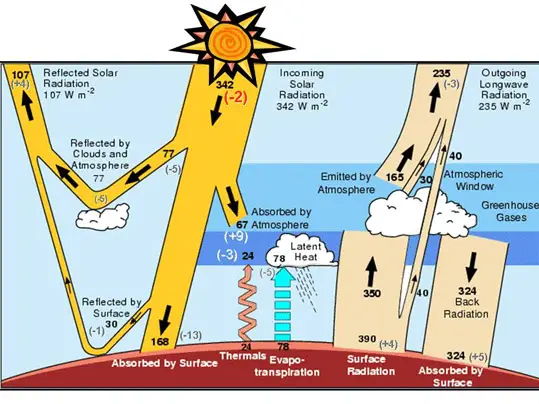


Now what are the possible solutions to a warming planet? The geoengineering groups have a few, very interesting, answers that I personally have never heard before. One school of thought is known as "Carbon Removal Techniques" or CRTs. An example of this would be placing a filter directly over smoke stacks that could remove greenhouse pollutants, without restricting efficiency, and would actually recycle some of the carbon to be facilitated for later use. This seems like a profitable endeavor to me, but why isn't it being employed?

One of the more radical tactics is SRM, or Solar Radiation Management. This includes painting the tops of buildings white to increase their reflectivity, thus allowing more solar radiation to escape. Some progressive scientists even endorse transforming (how?) deserts into reflective surfaces, thus locally cooling that area and reducing the average global temperature.

I think the most interesting of the proposed SRM solutions was to distribute football sized floating white surfaces across the world's oceans to increase the reflectivity of the majority of the Earth's largest surface (water). This would essentially erase any negative environmental outcomes (such as desert wildlife being destroyed from painting their ecosystem white). Now the cost-benefit analysis of such an immense oceanic project is a different story. It essentially will never happen. The speaker estimated that the covered area needed to reverse global temperature increases would be about 13 million square kilometers. Just to put this into perspective, the United States covers about 9 million square kilometers. This equates to distributing 2.5 billion such platforms and would cost an estimated $2,000 trillion. Ouch!

Another proposed solution would be what is known as "albedo modification." Albedo, for those who need an explanation, is a surfaces ability to reflect sunlight; rubber has poor albedo while snow has a large albedo. Cloud albedo modification would entail injecting salt into clouds to increase their droplet size, since a large water droplet obviously reflects more light than a small one. Again, this would increase the light escaping from the atmosphere and thus cool the planet. The Royal Society of London for the Improvement of Natural Knowledge, arguably the most respected scientific institution on the planet, prefers a slightly modified version of this. Known as Stratospheric Aerosol Distribution, this method of tackling temperature increase would involve introducing a relatively small, but extremely long-lived, amount of sulfur aerosol into the stratosphere. Such a solution would reflect the unwanted extra radiation away from the Earth before it could even reach the cloud level. This method seems to be reasonably cost effective, and can be implemented by current technology.

So, in essence, the debate as to what causes global warming is irrelevant. Simply, the Earth is warming, which is bad, and their are feasible solutions. What is a problem is that the US media seems to be hung up on the insignificant.

Can same sex corporations get married?

So the Supreme Court finally ruled on the case of corporate campaign spending. Susan Milligan, from the Boston Globe, sums the facts up nicely in saying,

Under the ruling, corporations and unions will not be able to contribute unlimited amounts directly to a candidate, but may spend what they please on behalf of a candidate. The money must be disclosed, the court said.

Ummmmm....why? What is the reasoning behind ruling on such an easily corruptable law? Well the court didn't have a choice, directly because of an archaic and unreasonable ruling that predates the sale of the first automobile.....not a joke. In the groundbreaking 1886 case of Santa Clara County v. Southern Pacific Railroad corporations were granted "personhood," which became a very effective tool for protecting wealthy shareholders from being responsible for nearly any legal obligations to their employees or, recently, victims. This is the essence of a LLC.

So yesterday the Supreme Court, under the legal precedent that corporations have human and civil rights as all persons do, had to rule that they are granted freedom of speech and are thus protected by the 1st amendment. I think David Kirkpatrick hits the nail on the head with his assertion that, "A lobbyist can now tell any elected official: if you vote wrong, my company, labor union or interest group will spend unlimited sums explicitly advertising against your re-election."

This new mechanism will surely destroy the small amount of chivalry that was still lingering in presidential elections, but the effect it will have on state and local elections will surely redefine the word "corruption". A few million dollars in the 2012 election will be chump change, but put that same financial resource behind your local mayoral candidate and you're in for trouble.


Thursday, January 21, 2010

Haiti

After yesterday's magnitude 5.9 earthquake, which is the first of many possible aftershocks, the European Union is now estimating that 200,000 are dead, along with an injured 250,000 and a newly homeless population of 1.5 million. By Sunday, the Pentagon says, there should be 16,000 US military troops in Haiti. The White House is now considering increasing that number to 20,000 in the weeks to come. But with this immense aid and daunting donation drives, we have to ask the question: why is Haiti too poor to survive on its own?

The history of US-Haitian relations is vast, but I'm going to begin reviewing Haiti's economy with the introduction of the FRAPH. The Front for the Advancement and Progress in Haiti was the paramilitary organization behind a coup started in 1993 and is responsible for the murder of nearly 5,000 Haitian civilians. Arguably its most infamous member, Emmanuel Constant, reaped a regular salary from the CIA and was appointed to power by the US Defense Intelligence Agency (DIA).

In an article from Z-magazine, during the violent upheaval of the Haitian government in the mid 90's, "refugees fleeing to the U.S. from the terror of the US-backed dictatorship were forcefully returned, in gross violation of international humanitarian law." Although one important refugee was given political asylum within the US and, to this day, lives in Queens. That refugee is Emmanuel Constant, the Haitian terrorist discussed in the previous paragraph. Haiti decided to convict Constant in absentia and regularly called for his extradition, but to no avail. Luckily in 2008, he was convicted of several mortgage fraud felonies in New York and was sentenced to 37 years in prison. Wow, what a nice guy.

But none of this directly addresses the question; why is the Haitian economy unable to provide a significant amount of self-reconstruction?

Well after the success of Emmanuel Constant's overthrow, the World Bank announced, "The renovated state must focus on an open economic strategy ... both national and foreign." Aww, that actually sounds legitimate. Well, it wasn't; almost immediately after the World Bank announcement, the Organization of American States declared an oil embargo on the entire nation. Furthermore, the newly democratized Haitian rice farmers had to compete against the subsidized US agriculturalists. Their inability to do so yielded a devastating financial depression of the working class majority. If this seems unbelievable, do a Google search of "NAFTA."

With all this being said, giving financial aid to Haiti is even more important than ever. What isn't important is placing 10,000 US troops in the disaster area and then subsequently waiting a week until clean drinking water was given to the victims. Michael Weisbrot writes:

On Monday, six days after the earthquake in Haiti, the US Southern Command finally began to drop bottled water and food from an air force C-17. US defence secretary Robert Gates had previously rejected such a method because of "security concerns".

In Gates' defense, he's quoted on CNN.com saying:

It seems to me that, without having any structure on the ground in terms of distribution, that an airdrop is simply going to lead to riots as people try and go after that stuff. So without any structure for distribution or to provide security when things become available, then it seems to me that's a formula for contributing to chaos rather than -- rather than preventing it

Seems like a valid point. But is refusal to distribute drinking water really the best solution? Let me offer an alternative solution to stop potential civil disputes over insufficient supplies of water;
DROP MORE WATER


False History

So I've obviously filled my last semester with "easy A" classes, but to my surprise a class titled "The Contemporary Enlightenment: Science, Technology, and Human Values" seems to not be as wishy-washy as the title emplies. We're currently talking about how the absence of important national concerns in US media seems to be a recurring theme. Why? Hopefully this class will explain that (one of the assigned books is Chomsky and Herman's Manufacturing Consent).

Well my daily perusing of The Guardian has, not shockingly, lead me to a direct example. One of today's top articles outlines the Alaskan Rep. senator Lisa Murkowski's disapproval of congressional abilities to potentially cap greenhouse emissions in her state. She argues that it will further promote unemployment and is quoted in saying, "[climate regulations are] under the guise of protecting the environment, it's set to unleash a wave of damaging new regulations that will wash over and further submerge our struggling economy."

Well, Lisa, I think that's a pretty steep connection. If you want to widen the divide between the economic classes, take a page out of your boss', Barack Obama's, book (see my previous post for the day.) Complete financial and legal freedom of the wealthiest domestic private industry in world history (a.k.a Wall Street) seems, at least in my perspective, to be a much more effective way of destroying John Q. Taxpayer's 401k. Maybe you didn't learn that when you were a member of Pi Beta Phi sorority. Maybe that's not fair. For a better understanding of your agenda, all we need to do is look at your voting record in the 2006 congressional year.

You voted:
  • against S.C. Resolution 83, intended to bolster energy security and lower energy-related environmental impacts
  • against an amendment to S. 728 which would make the Army Corps of Engineers more accountable for the environmental and economic impacts of their projects
  • for oil drilling in ANWR
  • for domestic offshore oil and gas drilling
Interesting; let's take a look at your top 5 campaign contributors for the last 5 years. Listed in order from highest paying:

1. Edison Chouest Offshore
2. Constellation Energy
3. Van Ness Feldman
4. Southern Co.
5. Exxon Mobile

Wow, almost unanimously energy corporations. For those of you who aren't aware, Van Ness Feldman is a law firm that specializes in representing energy conglomerates. I guess it isn't a shock that Murkowski's net worth in the year 2008 alone (which is the most recently reported year) went from $655,000 to over $2 million. Just something to think about.

Ok enough about Lisa Murkowski. The thesis of this post is that the NY Times, regarded as one of the nation's most legitimate main stream news sources, decided that this story wasn't important enough to post on their front page. The only mention of Murkowski's speech is in an editorial that can only be reached using the "search" bar at the top of the webpage. Wait a minute, maybe the NY Times had more important topics to discuss today. Fair enough, here is a list of a few of the front page stories on their website for today, 1/21/2010

Seeing is Disbelieving: What it felt like to play against Mark McGuire

Other People's Lives: 'Girl on the Train' is a seductive drama

ArtsBeat: Gym, tan, and the Jersey Shore. Discuss


My favorite is the last one, but hey, that's just me.

Here is a link to the Murkowski article on The Guardian


In the Beginning...

I'd like to start this freshly made blog with an inspiration from a Noam Chomsky's lecture entitled "Philosophies of Language and Politics." In this piece, prof. Chomsky discusses, along with a variety of other topics, the economics of political agendas and how such policies are manifested in presidential elections.

With this lecture in mind, I read the NY Times front page article entitled "Obama Moves to Limit Reckless Risks of Banks." Link here

Obama's declaration seems to contradict the past year of Wall Street behavior and the apparent precursors to current economic policy in his campaign contribution archives. According to Open Secrets, Goldman Sachs topped the list of contributors (second only to the University of California) with a substantial donation of ~$1,000,000.

It seems less than suprising, given the provided information, that Goldman Sachs was the beneficiary of slightly over $12 billion in bailout allocations. hmmm... This includes further complication with yesterdays newly reported findings that Goldman Sachs executive bonuses are likely to exceed $20 bil, with an average payout of over $600,000 per employee.

I wonder if the previously mentioned White House reaction to "limit reckless risks" will involve stopping the, virtually riskless, pocket stuffing endorsed directly by the Obama administration? That being said, I find it strikingly convenient that none of the US mainstream media(feel free to provide feedback) have yet to connect the dots on the proportionality of campaign contributions to bailout provisions. Hopefully some brave journalist, who has dreams of unemployment, with offer this to the public eye.